Range Repair
Wolf Burner Clicks But Will Not Light: What It Actually Means
A Wolf sealed burner that sparks forever without catching is almost never a gas supply problem. Here is what causes it, what you can check in five minutes, and where it stops being a DIY job.
- Signed
- Rafael Monteiro
- Role
- Cooking-appliance technician — ventilation and blowers
- In the trade
- 9 years
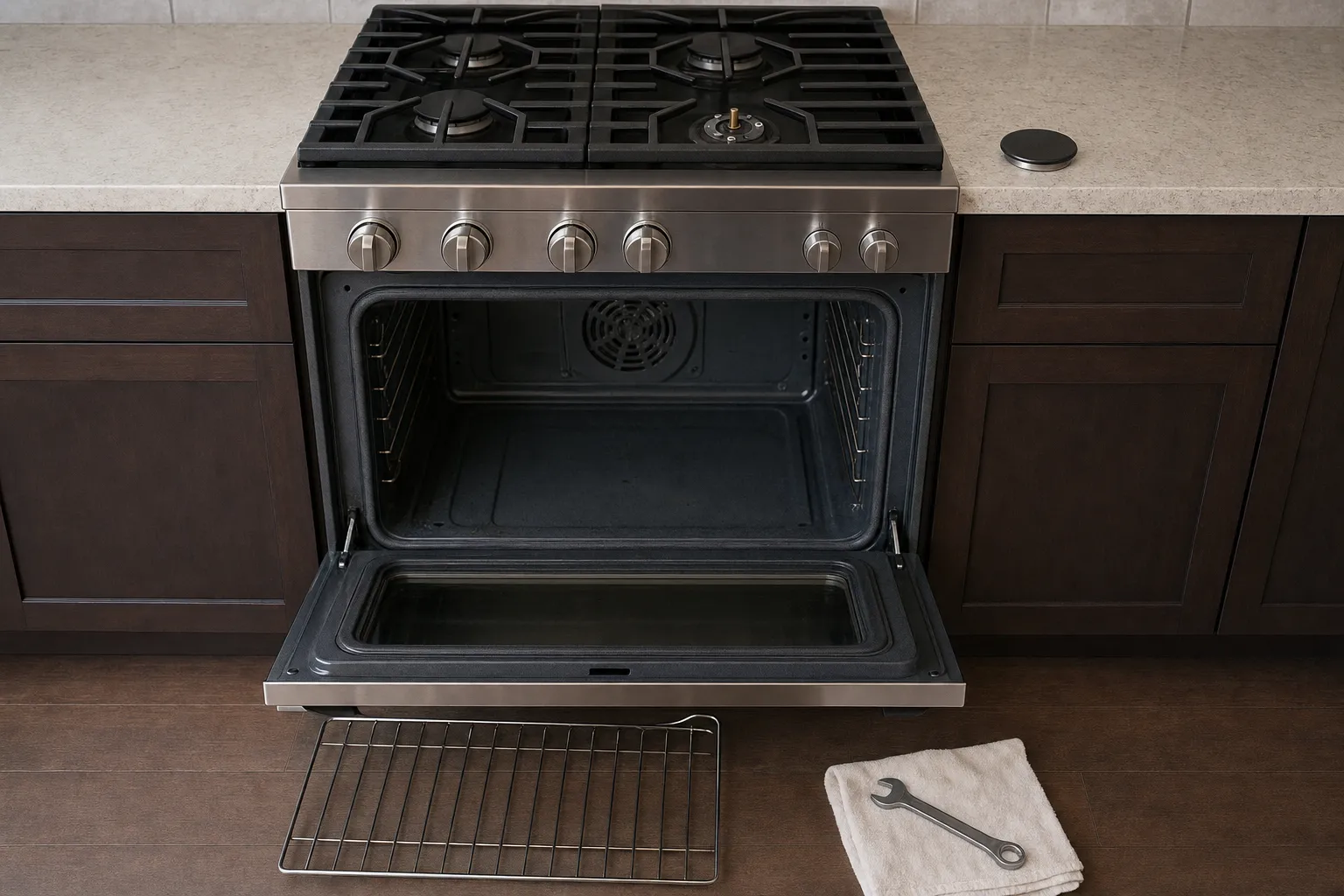
One burner ticking over and over without ever taking a flame is the call we get most on the Sammamish plateau, and the one people most often misdiagnose. The instinct is to assume something is wrong with the gas — a supply problem, a valve, a regulator. It almost never is. If the other burners light normally, the gas arriving at your range is fine by definition, and the fault is confined to the few inches around the burner that will not go.
What the clicking actually tells you
The clicking is the spark module doing its job. On a Wolf sealed burner, turning the knob past the ignition detent does two things at once: it opens the gas valve and it closes a switch that tells the spark module to fire the electrode. Wolf’s own guide puts it in one line: the igniter clicks until the burner is lit.
So a burner that clicks has power, has a working module, and has a switch that is closing. That eliminates a great deal. What it does not prove is that the spark is landing where it needs to, or that gas is reaching the burner port in the right quantity.
The two failure families that remain are simple to describe. Either the spark is not jumping the right gap to the right place, or gas is not arriving at that gap in a mixture that will catch. Everything below is a version of one of those two.
The four faults we find, in order
A wet or fouled electrode. By a wide margin the most common. The ceramic electrode sits in the burner well, and anything that puts moisture in that well — a boil-over, an enthusiastic wipe-down, a pan that spat — gives the spark an easier path to ground through the liquid than across the air gap to the burner cap. It clicks beautifully and lights nothing. Dried food deposits do the same thing by insulating the gap instead.
A burner cap seated wrong. Wolf’s guide asks for the cap to sit flat on the burner, and where a cap secures to the burner head, for it to be fastened tight. A cap that has been put back at a slight angle after cleaning moves the ports away from the electrode, and it does not take much. This one is worth checking before anything else because it costs nothing to fix.
A cracked electrode or a chafed lead. Ceramic cracks are often invisible. The spark still generates but leaks to ground through the crack instead of crossing to the cap. You can sometimes hear it — the click sounds duller and flatter than the ones on the working burners. The lead running back to the module can also chafe against the chassis over years of thermal cycling.
A blocked orifice or clogged port. Less common, but it happens in kitchens that fry a lot. Gas is arriving at the burner but not getting out of the ports near the electrode in a lightable quantity. The tell is a burner that eventually catches after several seconds with a small pop, or one that lights on one side of the ring only.
What to check yourself in five minutes
Turn the burner off and let everything cool completely before touching it.
Lift the burner cap off and look at the well underneath. If there is standing liquid, dry it thoroughly, then leave the cap off for a full day in a well-ventilated kitchen. Ceramic that has absorbed moisture takes far longer to dry than the surface suggests, and this alone fixes a large share of no-light calls that come in the day after a deep clean.
Look at the electrode itself. It should be clean, dry and standing proud, with a visible air gap to the burner. Deposits can be cleaned off gently with a dry toothbrush — never a wire brush, and never anything wet.
Reseat the cap so it sits flat without rocking. Then try to light it. Watch where the spark is going: it should jump cleanly and consistently to the same spot on the cap.
Compare the sound against a burner that works. Two burners clicking side by side tell you more than any amount of staring at one.
Where it stops being a DIY job
If the well is dry, the cap is seated and the electrode is clean, you have reached the end of what is sensible to do yourself. What remains needs a meter and a manometer: continuity on the electrode lead, output at the spark module, and manifold pressure read against the rating plate on the appliance.
That last one matters more than people expect. A range running on orifices meant for the other fuel can light reluctantly and burn with the wrong flame. It is not an ignition fault at all, but it presents as one.
The other case worth taking seriously is a burner that sparks with all the knobs in the off position. That points to a stuck switch or a failed module, and it is the one symptom on this page that means shut the range down at the wall and call someone straight away.
What a repair usually costs and takes
For the common outcomes, this is a small job. Electrodes and burner caps are inexpensive parts, and a spark module is a straightforward swap once the diagnosis has pinned the fault on it.
Orifice and pressure work is a different conversation — not expensive, but it needs doing properly and documented, because a range set up for the wrong fuel is a safety matter rather than an inconvenience. If that is what we find, you will get the manifold reading and the plate specification side by side before anything is changed.
What is almost never the answer is replacing the cooktop or the range. If somebody has quoted you for that on a clicking burner, get a second opinion before you sign anything.
Still unsure? Short answers
Can I carry on cooking on the other burners while this one clicks?
Yes, provided the clicking burner is turned fully off and you can smell no gas. A continuous spark with the knob off is different — shut the range down at the wall and call, because that means the switch or module is stuck closed.
Why did it start right after I cleaned the cooktop?
Water is the single most common cause. Cleaning floods the burner well, sits under the cap and shorts the spark to ground. Twenty-four hours of drying with the caps off resolves a large share of post-cleaning no-light calls.
Can I just replace the igniter myself?
The electrode itself is a serviceable part, but on most Wolf sealed burners it is bonded into an assembly that also carries the gas orifice and the burner ground. Getting it wrong leaves you with a burner that lights but runs rich, which is worse than one that does not light at all.