Oven Repair
Wolf Oven Heating Element Replacement: Fix It or Retire the Oven?
Replacing a burned-out Wolf oven heating element is usually worth doing, because the part is covered for five years from installation and the swap leaves your cabinetry alone. Here is how to tell when the whole oven is the better thing to replace.
- Signed
- Rafael Monteiro
- Role
- Cooking-appliance technician — ventilation and blowers
- In the trade
- 9 years
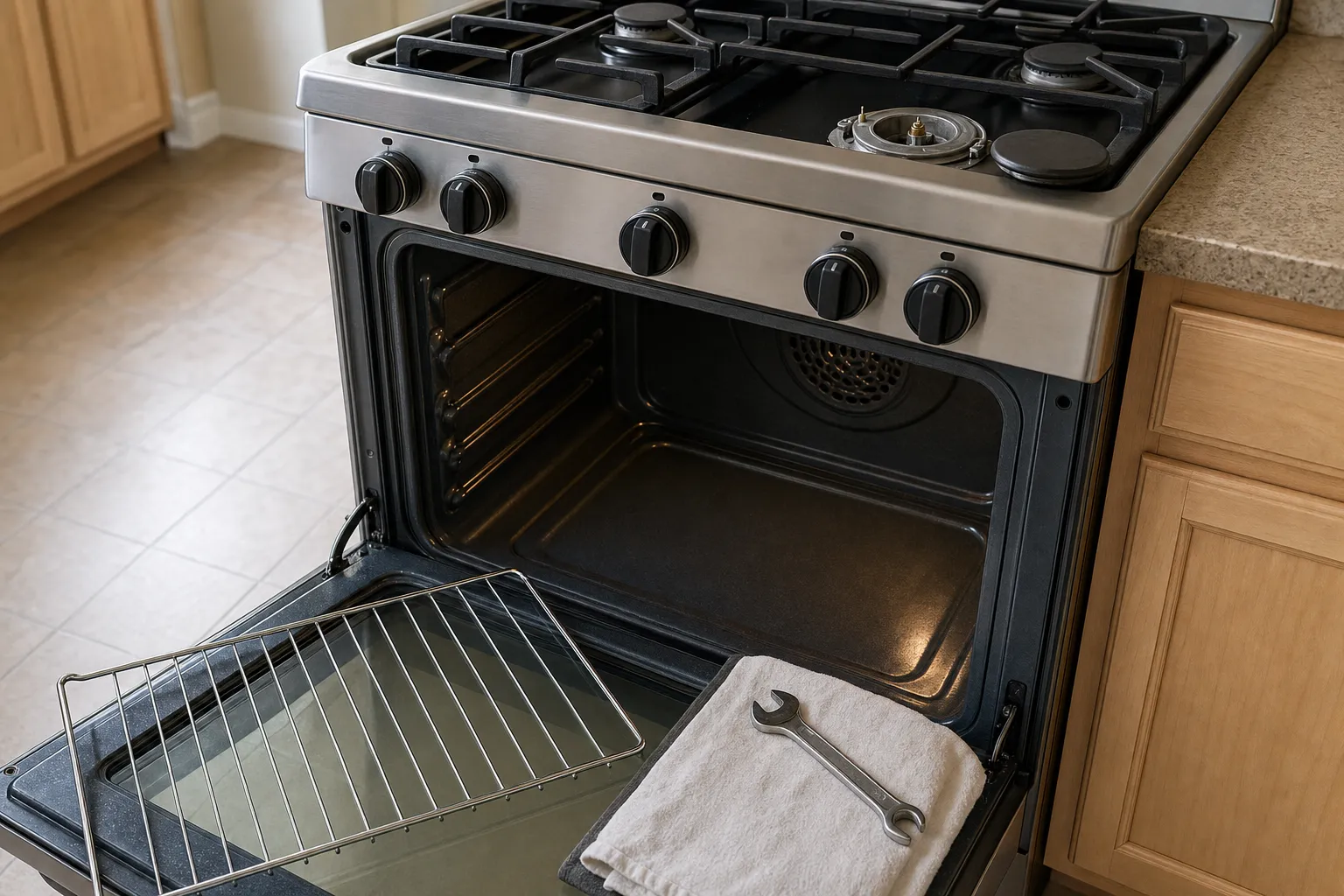
For most Wolf ovens, heating element replacement is the sensible repair. The element is a wear part, Wolf keeps electric heating elements under parts coverage for five years from installation, and swapping one leaves the oven, its cutout and your cabinetry exactly where they are. Replacing the whole oven makes sense in a narrower set of cases than people expect: usually an oven long past that five-year window that is losing its control board, its door seal or its convection fan at the same time as the element. Below is how to confirm the element really is the culprit, then the four questions that settle repair versus replacement for a built-in.
Make sure it is the element before ordering anything
A Wolf electric oven has more than one heat source. Broil comes from the element across the top of the cavity, bake from one underneath, and the convection modes add a fan at the back wall. On many built-in ovens the lower element is hidden beneath the floor panel, so you cannot simply look for a snapped coil. A few checks at home narrow it down:
- Choose Broil and watch the top element. It should glow an even orange within a few minutes. Dark stretches, a bubbled spot or a visible break mean it is finished.
- Choose Bake and time how long the oven takes to report that it is preheated. If that wait has crept up badly, or the control never says it is ready, suspect the lower element or the circuit feeding it.
- Try a convection mode. If Convection Roast gets hot while plain Bake stays lukewarm, the fault is confined to one heating circuit rather than the whole oven.
If every element glows but dishes still come out underdone, the element is probably healthy and the temperature sensor is misreading. Our guide to a Wolf oven running cold shows how to prove that with an oven thermometer. One reset is worth trying before you book anyone: switch off the oven’s breaker, wait a minute and switch it back on. That clears a control that froze partway through a cycle. It does nothing for a coil that has burned open.
Gas, dual fuel or wall oven: what is inside yours
Not every Wolf oven has an element at all. An all-gas GR range bakes with burners. In the 30-inch and 36-inch sizes the oven fires a bake burner rated at 30,000 Btu, with an 18,000 Btu burner up top for broiling; the 18-inch oven gets only the bake burner, and LP conversion leaves those ratings unchanged. When a GR oven refuses to heat, the igniter is the usual suspect, and an igniter or spark module typically runs $180–$480. Our Wolf range repair page covers that side of things.
Dual-fuel ranges pair a gas top with an electric oven, so they do use elements. If yours has an infrared griddle, look it up against recall 25-034 before anything else; Wolf has asked owners of affected ranges to stop using them and contact Wolf to arrange a free repair at home.
Wall ovens announce what they are in the model number. The opening letters give the type: a single oven starts with SO, a double with DO, a convection steam oven with CSO. Another pair gives the line and the look: TM, PM or CM for the M Series in Transitional, Professional or Contemporary trim, TE or PE for the E Series. On SO3050 and DO3050 models the serial tag hides behind the door; swing it open and check the lower left trim, and on a double use the bottom cavity. Have both numbers ready when you call, because the correct element depends on the exact model.
Four questions that decide repair or replace
How old is the oven?
Age matters mostly because of the warranty. For two years from the original installation, Wolf’s full warranty pays for parts and labor on a defective part, so a dead element in a young oven belongs with Wolf’s own service network. From the third year through the fifth, electric heating elements and electronic control boards stay covered as parts, but you pay for the labor. If you hire a technician outside Wolf’s network during that stretch, you contact Wolf to obtain the covered part, and Wolf will not refund an element you bought from a parts website. Because this business is an independent service that is not affiliated with Wolf, it pays to dig out your installation date before booking anyone, including us.
Which part actually failed?
An element on its own is one of the simpler oven repairs. A failed control board or touch panel is the costly one, and a convection fan or motor sits in the middle. These are typical ranges for common Wolf oven work, with the firm price given after diagnosis:
| Repair | Typical range |
|---|---|
| Oven thermostat or sensor calibration | $190–$420 |
| Convection fan or motor | $260–$630 |
| Door hinge, glass or seal | $270–$700 |
| Control board or touch panel | $420–$920 |
The element itself is priced once the technician confirms which one has failed and which part your model takes.
How often has it failed?
One burned element after years of cooking is ordinary wear. Two in quick succession is a symptom of something else. Elements that keep dying usually have a cause: a relay on the control board that sticks closed, a loose terminal that arcs, or aluminum foil spread across the oven floor. Wolf warns against lining the floor or side walls with foil and against setting cookware straight on the floor, because both harm the porcelain interior and void the warranty. Find and fix the cause, or the next element is on borrowed time.
What would replacement involve?
A built-in oven is not a slide-in appliance. A new unit has to match the cabinet cutout, the electrical supply and, for a double, the stacked height, and a different size or brand can mean trimming or rebuilding cabinetry. In a Sahalee or Pine Lake kitchen where the oven lives in a custom cabinet tower, that carpentry alone can outrun the repair you were hoping to avoid. For range owners the comparison is starker: a comparable professional range runs $7,530–$17,660 before installation. Replacement earns its keep when the oven is past its five-year coverage and two expensive parts are failing together, such as the board and the door seal, or when the porcelain cavity is chipped through.
Keeping the new element healthy
- Wipe grease off the broil element and out of the cavity before a self-clean. Wolf says smoke and burning smells during self-clean are normal and usually come from leftover food or grease, including grease sitting on the broil element, so a quick wipe first means less smoke and less strain.
- Keep foil and pans off the oven floor.
- Keep an eye on the door gasket. A torn one leaks heat and makes the elements work harder on every bake, and Wolf directs owners to have a torn M Series gasket replaced through service.
Booking a diagnosis in Sammamish
We work in Klahanie, Pine Lake, Sahalee and Trossachs. Our visit costs $89, which buys the drive out and a full diagnosis; approve the repair and that $89 is deducted from what you owe. Call (425) 920-9484 or use the booking button on this page, and keep the model and serial number close by. You will find more detail on our Wolf oven repair page.
Still unsure? Short answers
How do I know my Wolf oven is preheated?
Wait for the control to tell you the cavity has reached the temperature you set, rather than counting minutes. If that wait has grown much longer than it used to, or the oven reports ready but food still cooks slowly, a tired element or a drifting temperature sensor is the likely cause and worth having diagnosed.
How do I reset a Wolf oven that stopped heating?
Turn off the oven's breaker at the electrical panel, give it about a minute, then restore power and try Bake again. That clears a control that has locked up mid-cycle, but it cannot revive an element that has burned through, so an oven that stays cold after a reset has a failed part rather than a confused display.
Can I buy a Wolf heating element online and fit it myself?
You can, but inside the first five years it usually costs you money, because Wolf supplies covered heating elements only when you request them through Wolf and does not reimburse parts bought from other sellers. Some element jobs on a built-in oven also mean sliding the unit out of its cabinet, which is heavier and fussier than it looks.
Does the warranty pay for the labor to replace a Wolf oven element?
Only during the first two years. Wolf's full warranty covers parts and labor for two years from the original installation; from year three through year five, electric heating elements and control boards are still covered as parts, but the labor is on you. After five years both the part and the labor are yours to pay.
My Wolf oven door will not close properly. Does that affect heating?
Yes, a door that does not seal lets heat escape, so the elements stay on longer and preheat drags. Look for a bent hinge or a torn gasket; Wolf says a torn M Series door gasket has to be replaced, and door hinge, glass or seal work typically runs $270–$700, with the firm figure given after diagnosis.